Sisyphus, the Rock, and Why to Keep Going Even When Nothing Makes Sense
myth of sisyphus, albert camus, absurdism, existential philosophy, meaning of life, nihilism
Why keep going if nothing makes sense?
That is the question. It’s not theoretical, it’s not for a philosophical bar debate—it’s the question everyone asks themselves when they realize that life is basically pushing a rock up a hill, watching it roll back down, and repeating.
Albert Camus took this anguish and turned it into The Myth of Sisyphus (1942). And spoiler: he won’t give you a ready-made meaning. He will show you why continuing even without meaning might be the only honest answer.

What on earth is absurdism?
Before getting into Sisyphus itself, I need to understand absurdism—because it’s the core of everything.
The absurd isn’t in me. It isn’t in the world. It’s in the encounter.
Like this:
- I seek meaning, purpose, a reason for things.
- The world… doesn’t answer. It simply is.
- This clash? That is the absurd.
Camus isn’t saying “nothing matters” (that would be nihilism). He’s also not saying “create your own meaning” (that would be classic existentialism, like Sartre).
He’s saying: the absurd exists, it’s real, and trying to escape it is dishonest.
The context: Broken Europe, dead promises
Camus writes this right after World War II. All of Europe was on the ground—not just physically, but ideologically.
The grand narratives had broken:
- Religion? God was dead (thanks, Nietzsche).
- Rational progress? It ended in concentration camps and atomic bombs.
- Absolute morality? It collapsed.
So absurdism doesn’t arise from nowhere. It’s born when you realize that the world’s promises were lies.
The Myth of Sisyphus: The perfect metaphor
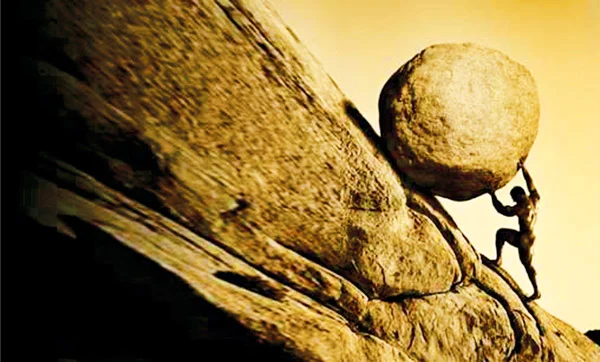
Sisyphus was condemned by the gods to push a rock up a hill. Eternally. When it reaches the top, the rock rolls back down. And he starts over.
There is no:
- Redemption
- Progress
- Finality
- Meaning
It’s just the effort, the rock, the fall. Repeat.
And Camus uses this to ask: if life is this absurd, why not give up?
This is the only truly serious philosophical question, according to him. The rest is just window dressing.
Camus’s answer: Conscious revolt
Camus rejects three exits:
- Physical suicide—literally giving up.
- Philosophical suicide—deceiving oneself with blind faith, forced hope, or invented meaning.
- Passive resignation—accepting and suffering in silence.
His answer? Revolt.
Not revolt against the absurd (you can’t win). But revolt within the absurd. To keep pushing the rock, knowing it will fall, but continuing anyway.
To live without appeal. Without hope of redemption. Only lucidity.
”One must imagine Sisyphus happy”
This is the key phrase of the book. And it does not mean:
- ❌ “Be positive!”
- ❌ “Find the bright side!”
- ❌ “Pretend everything is fine!”
It means:
Sisyphus’s victory lies in expecting nothing from the rock.
He doesn’t expect the rock to stay at the top. He doesn’t expect the punishment to end. He knows what it is, accepts it, and masters the moment of the descent.
Happiness doesn’t come from an external meaning. It comes from the full awareness of the absurd. From looking at the rock and thinking: “this is it. and that’s okay.”
It’s not optimism. It’s radical lucidity.
And in real life?
Okay, but what about me? I’m not a condemned Greek king. I just wake up, work, sleep, repeat.
That’s the thing. You are Sisyphus.
The routine without a clear purpose, the work that doesn’t lead where they promised, the efforts that crumble, the goals you reach only to realize nothing has changed—all of that is the rock.
And what Camus tells you isn’t “find meaning in this.” It’s:
If you’re already pushing the rock, at least do it awake.
Don’t romanticize suffering. Don’t invent purpose where there is none. But don’t give up either.
Keep going. Consciously.
Final thoughts (mine)
Absurdism doesn’t give me easy consolation. But it gives me something more valuable: honesty.
I don’t need to pretend that life has a secret plan. I don’t need to believe in future redemption. I don’t need to delude myself.
I can just… keep going. Knowing the rock will fall. And that’s okay.
As Camus himself said:
“The struggle itself toward the heights is enough to fill a man’s heart.”
The rock will fall. But the descent is mine.
Useful references:
- CAMUS, Albert. The Myth of Sisyphus. Penguin Classics, 2005.
-
Britannica: Absurdism britannica.com
-
Stanford Encyclopedia: Camus plato.stanford.edu