If fossils are so rare, why do we find so many dinosaurs?
Discover why it seems we find many dinosaur fossils when fossilization is extremely rare. The answer involves 165 million years, perception bias, and the brutal mathematics of extinction.
If fossils are so rare, why do we find so many dinosaurs?
The short answer: we don’t find that many dinosaurs. It seems like we do because museums, documentaries, and books give the impression of abundance — but in reality, we know only about 700-900 species of dinosaurs, and this represents a microscopic fraction of the species that actually existed over 165 million years. Fossilization is absurdly rare, and what we find is basically a winning ticket in the geological lottery.
When I started studying paleontology, I had this same impression: “wow, there are dinosaurs everywhere — Tyrannosaurus, Triceratops, Velociraptor, Brachiosaurus…”. But then you look at the numbers and realize how brutal the mathematics of extinction really is. It’s estimated that somewhere between 1,000 to 10,000 genera of dinosaurs existed throughout the Mesozoic Era. And we know less than 10% of that.
And that’s what I need to write about. Because understanding why fossils are rare — and why dinosaurs specifically appear more often — reveals how fossilization works, what gets preserved and what disappears forever.
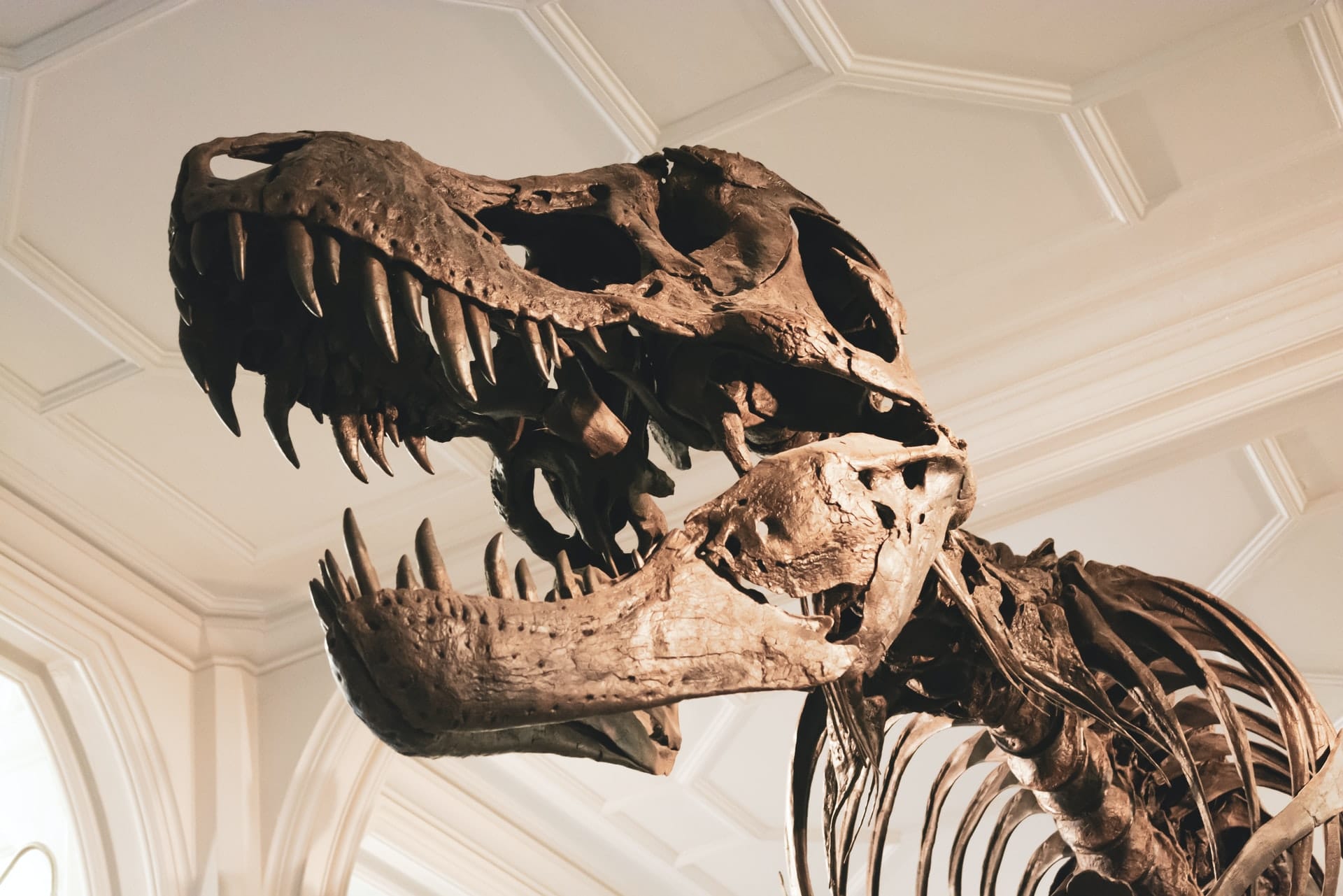
The illusion of abundance (or: museum bias)
Here’s the first mind trick: you only see the fossils that were found.
Sounds obvious, but think about it: when you go to a natural history museum, there are dozens of dinosaur skeletons. When you watch a documentary, it seems like paleontologists are always finding bones. When you read about it, every article mentions new species being discovered.
This creates an illusion of abundance. But what you don’t see is:
- The billions of dinosaurs that died and left no trace whatsoever
- Species that lived in environments where fossilization is nearly impossible (dense forests, mountains)
- Fossils that exist but are buried in inaccessible places (ocean floor, under glaciers, inside mountains)
- Fossils that were destroyed by erosion, tectonics, volcanism over millions of years
Paleontology is the science of studying what survived — not what existed.
And what survived is a biased, small sample full of holes.

The time scale is absurd (and changes everything)
Let’s put this in perspective. Dinosaurs dominated Earth from the Upper Triassic until the end of the Cretaceous — approximately from 230 million years ago to 66 million years ago. That’s 165 million years of reign.
To compare:
- Modern humans (Homo sapiens) have existed for ~300,000 years
- All of human civilization is about 10,000 years old
- Dinosaurs existed for 550 times longer than our entire species’ existence
Now imagine: in 165 million years, how many generations of dinosaurs lived? How many individuals were born, grew up, died? The estimate is trillions of dinosaurs throughout this period.
And we know fossils of perhaps a few hundred thousand individuals (being generous). Most are fragments — a tooth here, a vertebra there. Complete skeletons? Extremely rare.
165,000,000 years of dinosaurs
÷ ~700-900 known species
≈ 1 known species every ~200,000 years
This assumes uniform distribution — which is not true. Some epochs have many more fossils than others (Morrison Formation, Hell Creek Formation), others are nearly empty.
How fossilization works (spoiler: it’s extremely rare)
Here’s the problem: nature is very good at recycling organic matter.
When a dinosaur died, the most likely scenario was:
- Predators/scavengers eat the body
- Bacteria decompose what’s left
- Weather (rain, wind, sun) disintegrates exposed bones
- In weeks/months, nothing remains
For fossilization to happen, you need a very specific combination of factors:
Necessary conditions for fossilization:
| Factor | Why it matters |
|---|---|
| Rapid burial | Bones need to be covered by sediment before being destroyed |
| Anoxic environment | No oxygen = fewer bacteria = slower decomposition |
| Water present | Minerals dissolved in water replace organic material (permineralization) |
| Pressure and time | Sediments compact, become rock, preserve shape |
| Geological luck | Fossil must not be destroyed by tectonics, erosion, volcanism over the next millions of years |
| Eventual exposure | Needs to return to surface to be found (erosion, tectonic uplift) |
The probability of all this happening? Estimates vary, but something like 1 in 10,000 to 1 in 1,000,000 — depending on the animal, environment, epoch.
[IMAGE: Infographic showing fossilization stages: death → burial → mineralization → exposure]
Why do dinosaurs specifically appear more?
Ok, but if fossils are so rare, why do dinosaurs seem to have more representation than other animals from the same era? Good question. There are several reasons:
1. Size matters
Dinosaurs were large. Even the small ones were the size of chickens/dogs. The big ones? Argentinosaurus reached 30-35 meters in length and weighed ~70-100 tons.
Large, dense bones fossilize better. They’re more resistant, have more mass to mineralize, and are easier to find afterward (you stumble upon a Brachiosaurus femur more easily than a mouse bone).
2. Lived in favorable environments
Many dinosaurs lived near rivers, lakes, floodplains — places where sediment accumulates quickly. Died near the river? Flood covers the body with mud. Boom, first step of fossilization.
Compare with forest or mountain dinosaurs — we hardly know these, because forests don’t preserve well (acidic soil, rapid decomposition, little sediment).
3. Dense and mineralized bones
Dinosaurs had bones with high bone density (especially the large ones, which needed to support absurd weight). More mineral = better fossilization.
Compare with soft tissues — muscles, skin, internal organs. These almost never fossilize. That’s why practically every dinosaur fossil is just bones (and teeth, which are even harder).
4. Human interest = more search effort
Let’s be honest: dinosaurs are cool. So there are more people looking, more funding, more expeditions. If you search more, you find more.
An example: fossils of Mesozoic mammals (which lived alongside dinosaurs) are extremely rare — but part of this is because they were small, nocturnal, and lived in environments bad for fossilization. Another part is that nobody’s mounting expeditions to find Cretaceous mammals — doesn’t make headlines.

What we’re missing (and will never know)
Here’s the part that makes me a bit melancholic: the vast majority of dinosaur species will never be known.
Think about dinosaurs that:
- Lived in dense forests (acidic soil destroys bones)
- Were small (fragile bones, hard to find)
- Lived in mountainous regions (little sediment, lots of erosion)
- Inhabited islands that are now submerged or destroyed by tectonics
- Existed in periods with few accessible rock outcrops today
And there’s more: even when we find fossils, they’re usually fragments. A tooth. A vertebra. Part of a femur. Reconstructing an entire dinosaur from this is detective work — and lots of educated guessing.
“We know more about the surface of Mars than about the dinosaurs that lived on our own planet.”
— Phrase I just made up but it’s true
Some examples of what we’ve lost:
- Soft-skinned dinosaurs: We know some had feathers, others scales — but 90% of species? No idea.
- Behavior: Fossils don’t show how they lived, hunted, raised young (we only infer by comparison)
- Colors: Some rare fossils preserved melanosomes (pigment cells), but most? Educated guess based on modern birds.
- Sounds: How did a Parasaurolophus sound? We simulate with computers, but we’ll never know.
Questions I had (and the answers)
“But what about the ‘complete’ fossils we see in museums?”
Most are reconstructions. They found 40% of the skeleton, the rest is modeling based on comparative anatomy. Or worse: they combined bones from several individuals of the same species. 100% complete skeletons from a single individual? Extremely rare — like Sue (T. rex) at the Field Museum, which is 90% complete.
“If fossilization is so rare, how do you explain places like the Morrison Formation or Hell Creek, which have fossils everywhere?”
They’re geological hotspots — regions where conditions were perfect for fossilization (floodplains, shallow lakes, rapid sedimentation). The Morrison Formation (USA, Upper Jurassic) is like the Disneyland of dinosaur fossils. But it represents a very specific geographical and temporal area — not representative of the whole world.
“Are marine/flying dinosaurs also rare?”
Yes and no. Marine reptiles (ichthyosaurs, plesiosaurs, mosasaurs) fossilize relatively well because ocean = rapid sediment. But pterosaurs (flying reptiles)? Extremely rare — hollow, light bones fossilize poorly. Most pterosaurs we know come from Lagerstätten (exceptional deposits like the Solnhofen limestone, Germany).
“What about fossilized footprints?”
Trace fossils (tracks, footprints, coprolites) are more common than bones in some places — because they don’t need burial of the body, just mud that hardens. But they have a problem: you don’t know which species made the footprint. You only know approximate size and behavior.
“Are there more fossils waiting to be found?”
Definitely. But most are in inaccessible places — Antarctica, ocean floor, inside mountains. Or they were destroyed. Or they’re in countries where paleontology isn’t a priority (lack of funding, conflicts, etc).
Final thoughts (and why this fascinates me)
There’s something poetically sad about knowing that most dinosaurs that existed — the species, the individuals, the lives — disappeared without leaving any trace. It’s as if they never existed.
165 million years of evolution, adaptation, speciation… and we know less than 1% of the species. Trillions of animals were born, lived, died — and became nothing. Dust. Atoms recycled into other life forms.
The fossils we find? They’re the lucky ones. The winning tickets in the cosmic lottery. They died in the right place, at the right time, were covered by the right mud, remained untouched by millions of years of geological catastrophes, and — by pure chance — returned to the surface in a place where humans would find them.
And even then, what we have are fragments. Shadows of shadows. A bone here, a tooth there. We try to reconstruct these giants from crumbs — and it’s incredible that we accomplish so much with so little.
But this also gives me hope. Because every new fossil we find — each footprint, each vertebra, each jaw fragment — is a window into a world that no longer exists. It’s a message from the deep past. It’s Earth telling its own story.
And there’s something deeply human about wanting to hear that story. About digging rocks under the scorching sun of the Gobi Desert just to find a piece of 70-million-year-old bone. About spending years studying a single species. About trying to understand what it was like to live on a planet where 30-meter reptiles walked across plains that are now paved roads.
We’ll never know all the dinosaurs. Not even close. But each one we discover is a small victory against oblivion. It’s life defeating extinction — at least in memory.
💡 Summary in 3 points:
- We don’t find “that many” dinosaurs — we know 700-900 species out of an estimated thousands/millions total. It seems like a lot due to museum and media bias.
- Fossilization is absurdly rare — requires rapid burial, anoxic environment, mineralization, geological stability for millions of years, and eventual exposure. Probability: ~1 in 10,000 to 1 in 1,000,000.
- Dinosaurs fossilize better than other animals — they were large (dense bones), lived in floodplains (rapid sediment), and we have search bias (they’re cool, so we look more).
References:
-
Natural History Museum: How are fossils formed? nhm.ac.uk
-
Smithsonian: Dinosaur Fossils naturalhistory.si.edu
- BENTON, Michael J. Vertebrate Palaeontology. 4th ed. Wiley-Blackwell, 2014.
-
PBS Eons: Why Is The Fossil Record So Incomplete? pbs.org
- PROTHERO, Donald R. Bringing Fossils to Life: An Introduction to Paleobiology. 3rd ed. Columbia University Press, 2013.
Personal note: Got curious about Lagerstätten — these exceptional deposits where even soft tissues fossilize (like Burgess Shale in the Cambrian). How were conditions so specific that they preserved even trilobite antennae? And why do some geological periods have more Lagerstätten than others? Material for a future post.